Good to know
What conversion actually changes
Four things happen. The frame is resized to the destination format's exact dimensions and aspect ratio. The head is scaled so its chin-to-crown height falls inside the published millimetre range. The background is replaced with the shade that format requires. And the file is encoded with a real DPI value and, where the authority publishes one, a file size inside the accepted range.
The limits of conversion
It is worth being clear about what cannot be recovered. If the original does not include image above your hair, the head cannot be scaled down into range. If it was taken at arm's length, the perspective distortion is baked in. If the light came from overhead, the shadows under your eyes stay. If it is blurry or low resolution, it stays soft. Conversion is geometry and encoding, not restoration.
One source, several destinations
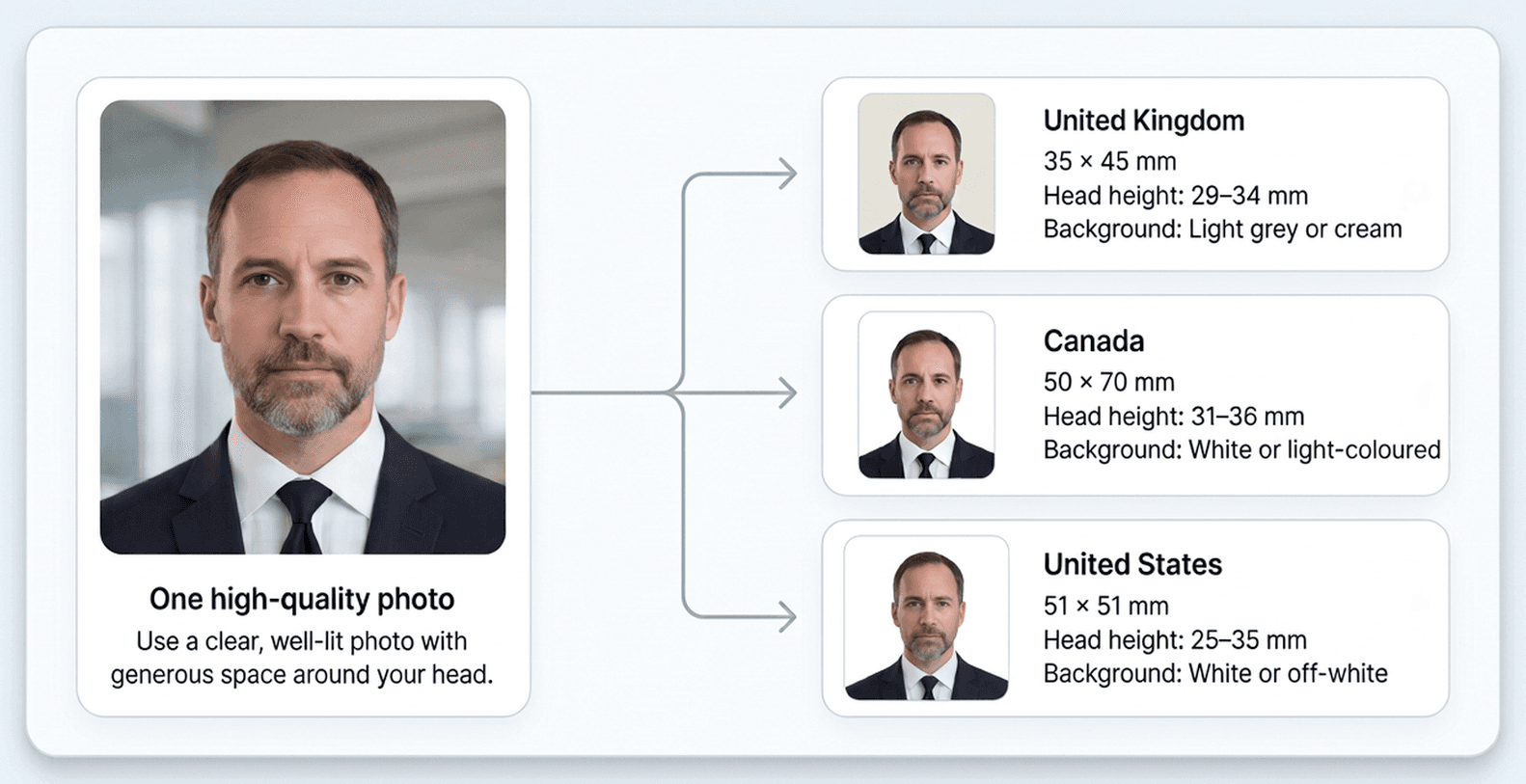
If you are applying to more than one country, take a single high-resolution photo with generous space around your head and convert it separately for each. Because every export recalculates the scale from your chin and crown, the same source can satisfy Canada's 31-36 mm rule and the UK's 29-34 mm rule even though the numbers differ. What you must not do is convert once and reuse the output file.
Print and digital in one session
For formats with published digital rules, export the print version and the digital version separately from the same crop. The print file carries the correct DPI for physical size; the digital file matches the portal's pixel dimensions and kilobyte cap. Downloading both takes a few seconds and avoids a second round of work if the authority asks for the other one.
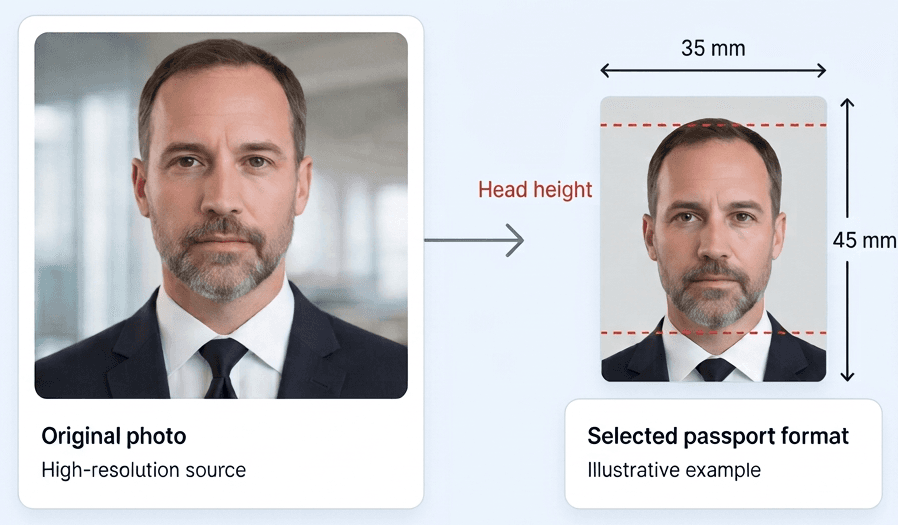
Exact dimensions
Resized to format
Correct head size
Scaled to requirements
Required background
Set to selected format
Correct DPI & file size
Encoded for export