Good to know
The crop is a calculation, not a composition
Most online croppers give you a rectangle with a fixed aspect ratio and let you drag it around. That gets the outer shape right and ignores the rule that actually decides the application. Every specification defines how tall your head must be inside that rectangle, measured from the bottom of the chin to the top of the head including hair.
So the crop position and scale are not a matter of taste. Once the chin and crown are located, there is exactly one scale that puts the head in range, and one vertical offset that puts the eye line where it belongs. That is what happens here, and the resulting measurement is displayed so you can check it.
What makes a photo uncroppable
The single most common problem is not enough image above the head. If your original is already cropped close to your hairline, there is nothing to work with: scaling the head down to fit the required range would need image above the crown that does not exist. The compliance panel will tell you the head is cut off rather than silently producing a bad file.
The other blocker is distance. A photo taken at arm's length places the lens around 40 cm from your face, which visibly enlarges the nose and forehead relative to the ears. Cropping cannot undo lens perspective, and biometric checks are sensitive to it.
Check the resolution warning
Cropping throws away pixels and the remainder gets scaled up to the output size. From a 12 megapixel phone photo this is invisible. From a small image pulled off social media, it produces a soft, slightly mushy print, and poor quality is a rejection reason in its own right. The compliance panel flags a source under 600 pixels on the short side.
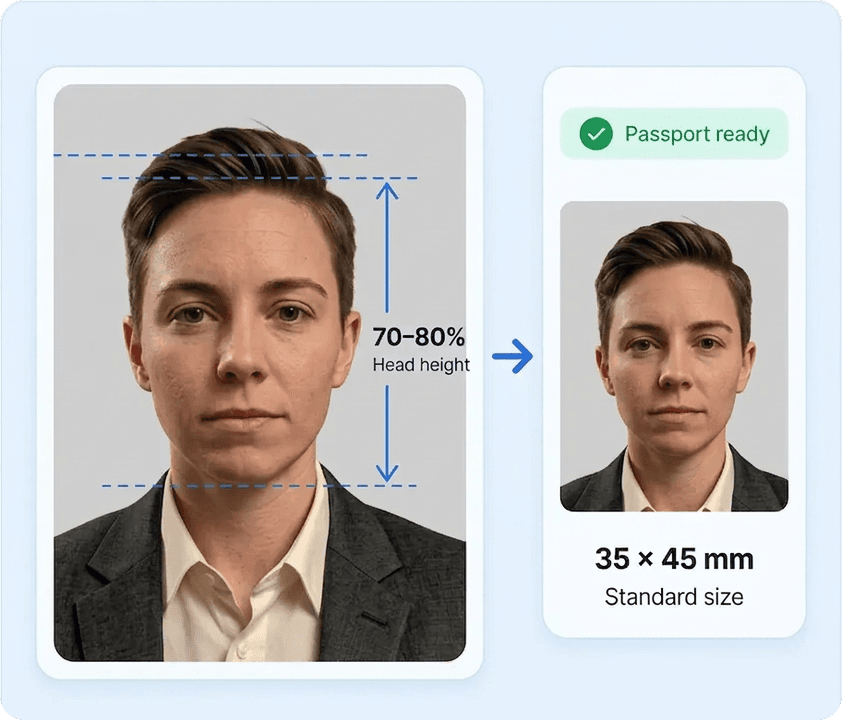
Correct head size
Meets official requirements
Automatic alignment
Eyes in the right position
Compliance check
Validates size and resolution