Loading…
Loading…
A pixel dimension only means something once you fix a DPI, because pixels describe data while the specification describes a physical photo. Here is every format at both 300 and 600 DPI.
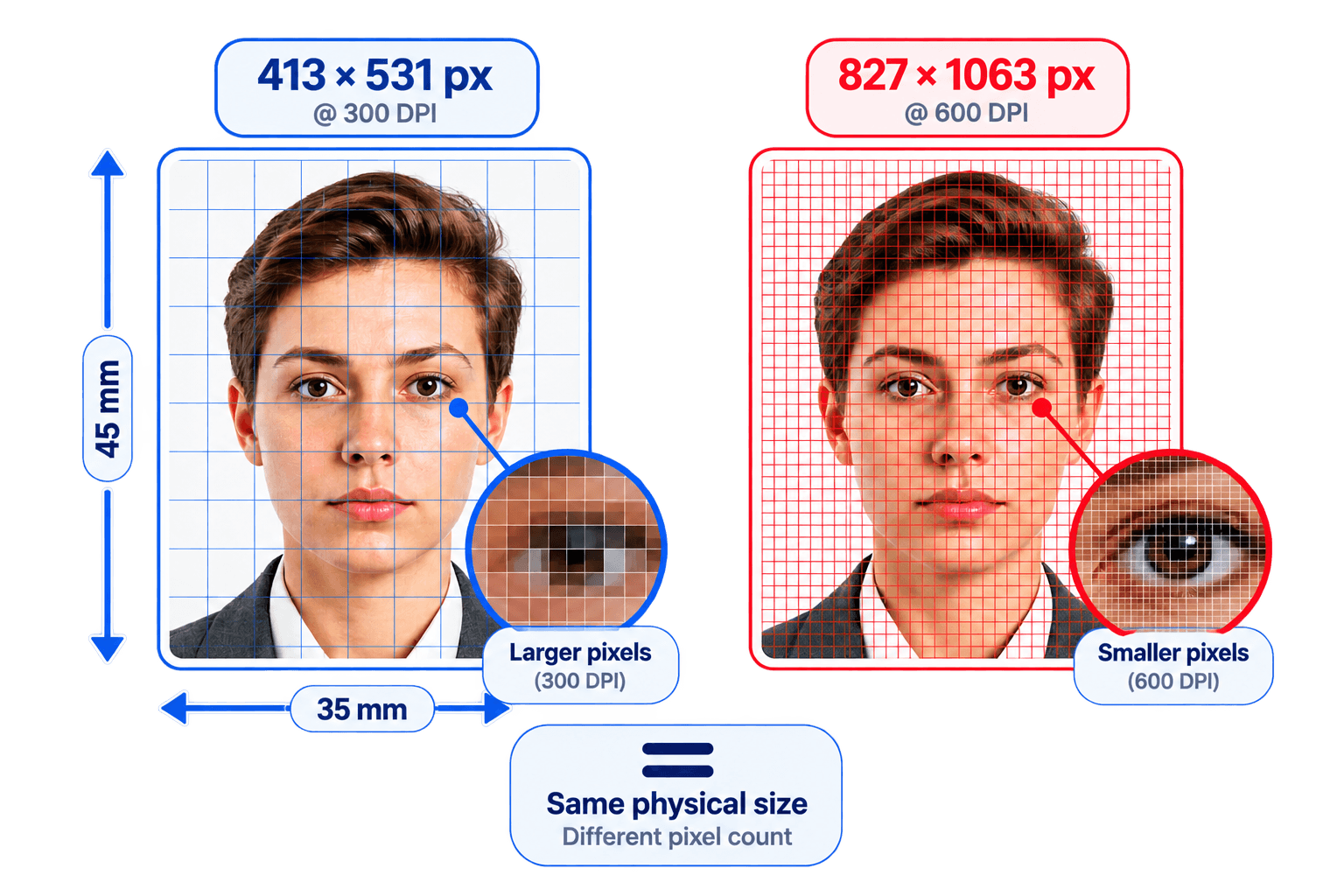
Calculated from the published millimetre size. 300 DPI is the practical print standard; 600 DPI is requested by some authorities for digital submissions.
| Document | 300 DPI | 600 DPI | Millimetres |
|---|---|---|---|
 Argentina passport photo Argentina passport photo | 472 x 472 px | 945 x 945 px | 40 x 40 mm |
 Australia passport photo Australia passport photo | 413 x 531 px | 827 x 1063 px | 35 x 45 mm |
 Austria passport photo Austria passport photo | 413 x 531 px | 827 x 1063 px | 35 x 45 mm |
 Bangladesh passport photo Bangladesh passport photo | 531 x 650 px | 1063 x 1299 px | 45 x 55 mm |
 Belgium passport photo Belgium passport photo | 413 x 531 px | 827 x 1063 px | 35 x 45 mm |
 Brazil passport photo Brazil passport photo | 591 x 827 px | 1181 x 1654 px | 50 x 70 mm |
 Canada citizenship photo Canada citizenship photo | 591 x 827 px | 1181 x 1654 px | 50 x 70 mm |
| Canada passport photo | 591 x 827 px | 1181 x 1654 px | 50 x 70 mm |
| Canada PR card photo | 591 x 827 px | 1181 x 1654 px | 50 x 70 mm |
| IRCC digital photo | 413 x 531 px | 827 x 1063 px | 35 x 45 mm |
 Chile passport photo Chile passport photo | 413 x 531 px | 827 x 1063 px | 35 x 45 mm |
 China passport photo China passport photo | 390 x 567 px | 780 x 1134 px | 33 x 48 mm |
| Chinese visa photo | 390 x 567 px | 780 x 1134 px | 33 x 48 mm |
 Colombia passport photo Colombia passport photo | 354 x 472 px | 709 x 945 px | 30 x 40 mm |
 Czechia passport photo Czechia passport photo | 413 x 531 px | 827 x 1063 px | 35 x 45 mm |
 Denmark passport photo Denmark passport photo | 413 x 531 px | 827 x 1063 px | 35 x 45 mm |
 Egypt visa photo Egypt visa photo | 472 x 709 px | 945 x 1417 px | 40 x 60 mm |
 Ethiopia passport photo Ethiopia passport photo | 413 x 531 px | 827 x 1063 px | 35 x 45 mm |
 Finland passport photo Finland passport photo | 425 x 555 px | 850 x 1110 px | 36 x 47 mm |
 France passport photo France passport photo | 413 x 531 px | 827 x 1063 px | 35 x 45 mm |
 Germany passport photo Germany passport photo | 413 x 531 px | 827 x 1063 px | 35 x 45 mm |
 Ghana passport photo Ghana passport photo | 413 x 531 px | 827 x 1063 px | 35 x 45 mm |
 Greece passport photo Greece passport photo | 472 x 709 px | 945 x 1417 px | 40 x 60 mm |
 India passport photo India passport photo | 413 x 531 px | 827 x 1063 px | 35 x 45 mm |
| India visa photo | 600 x 600 px | 1200 x 1200 px | 50.8 x 50.8 mm |
| OCI card photo | 600 x 600 px | 1200 x 1200 px | 50.8 x 50.8 mm |
 Indonesia passport photo Indonesia passport photo | 413 x 531 px | 827 x 1063 px | 35 x 45 mm |
 Ireland passport photo Ireland passport photo | 413 x 531 px | 827 x 1063 px | 35 x 45 mm |
 Israel passport photo Israel passport photo | 413 x 531 px | 827 x 1063 px | 35 x 45 mm |
 Italy passport photo Italy passport photo | 413 x 531 px | 827 x 1063 px | 35 x 45 mm |
 Japan passport photo Japan passport photo | 413 x 531 px | 827 x 1063 px | 35 x 45 mm |
 Kenya passport photo Kenya passport photo | 413 x 531 px | 827 x 1063 px | 35 x 45 mm |
 Malaysia passport photo Malaysia passport photo | 413 x 591 px | 827 x 1181 px | 35 x 50 mm |
 Mexico passport photo Mexico passport photo | 413 x 531 px | 827 x 1063 px | 35 x 45 mm |
 Nepal passport photo Nepal passport photo | 413 x 531 px | 827 x 1063 px | 35 x 45 mm |
 Netherlands passport photo Netherlands passport photo | 413 x 531 px | 827 x 1063 px | 35 x 45 mm |
 New Zealand passport photo New Zealand passport photo | 413 x 531 px | 827 x 1063 px | 35 x 45 mm |
 Nigeria passport photo Nigeria passport photo | 413 x 531 px | 827 x 1063 px | 35 x 45 mm |
 Norway passport photo Norway passport photo | 413 x 531 px | 827 x 1063 px | 35 x 45 mm |
 Pakistan passport photo Pakistan passport photo | 413 x 531 px | 827 x 1063 px | 35 x 45 mm |
 Philippines passport photo Philippines passport photo | 413 x 531 px | 827 x 1063 px | 35 x 45 mm |
 Poland passport photo Poland passport photo | 413 x 531 px | 827 x 1063 px | 35 x 45 mm |
 Portugal passport photo Portugal passport photo | 413 x 531 px | 827 x 1063 px | 35 x 45 mm |
 Qatar visa photo Qatar visa photo | 413 x 531 px | 827 x 1063 px | 35 x 45 mm |
 Russia passport photo Russia passport photo | 413 x 531 px | 827 x 1063 px | 35 x 45 mm |
 Saudi Arabia visa photo Saudi Arabia visa photo | 472 x 709 px | 945 x 1417 px | 40 x 60 mm |
 Schengen visa photo Schengen visa photo | 413 x 531 px | 827 x 1063 px | 35 x 45 mm |
 Singapore passport photo Singapore passport photo | 413 x 531 px | 827 x 1063 px | 35 x 45 mm |
 South Africa passport photo South Africa passport photo | 413 x 531 px | 827 x 1063 px | 35 x 45 mm |
 South Korea passport photo South Korea passport photo | 413 x 531 px | 827 x 1063 px | 35 x 45 mm |
 Spain passport photo Spain passport photo | 307 x 378 px | 614 x 756 px | 26 x 32 mm |
 Sri Lanka passport photo Sri Lanka passport photo | 413 x 531 px | 827 x 1063 px | 35 x 45 mm |
 Sweden passport photo Sweden passport photo | 413 x 531 px | 827 x 1063 px | 35 x 45 mm |
 Switzerland passport photo Switzerland passport photo | 413 x 531 px | 827 x 1063 px | 35 x 45 mm |
 Thailand passport photo Thailand passport photo | 413 x 531 px | 827 x 1063 px | 35 x 45 mm |
 Türkiye passport photo Türkiye passport photo | 591 x 709 px | 1181 x 1417 px | 50 x 60 mm |
 UAE visa photo UAE visa photo | 508 x 650 px | 1016 x 1299 px | 43 x 55 mm |
 UK passport photo UK passport photo | 413 x 531 px | 827 x 1063 px | 35 x 45 mm |
 US passport photo US passport photo | 600 x 600 px | 1200 x 1200 px | 50.8 x 50.8 mm |
| US visa photo | 600 x 600 px | 1200 x 1200 px | 50.8 x 50.8 mm |
| USCIS photo | 600 x 600 px | 1200 x 1200 px | 50.8 x 50.8 mm |
 Vietnam passport photo Vietnam passport photo | 472 x 709 px | 945 x 1417 px | 40 x 60 mm |
Please verify before you submit. Photo specifications change and the accepting officer has the final say. We link to the official source on every format page, and our requirements guide explains what reviewers actually check.
Ready to make your photo?
Free, no watermark, and your photo never leaves your device.
The basics
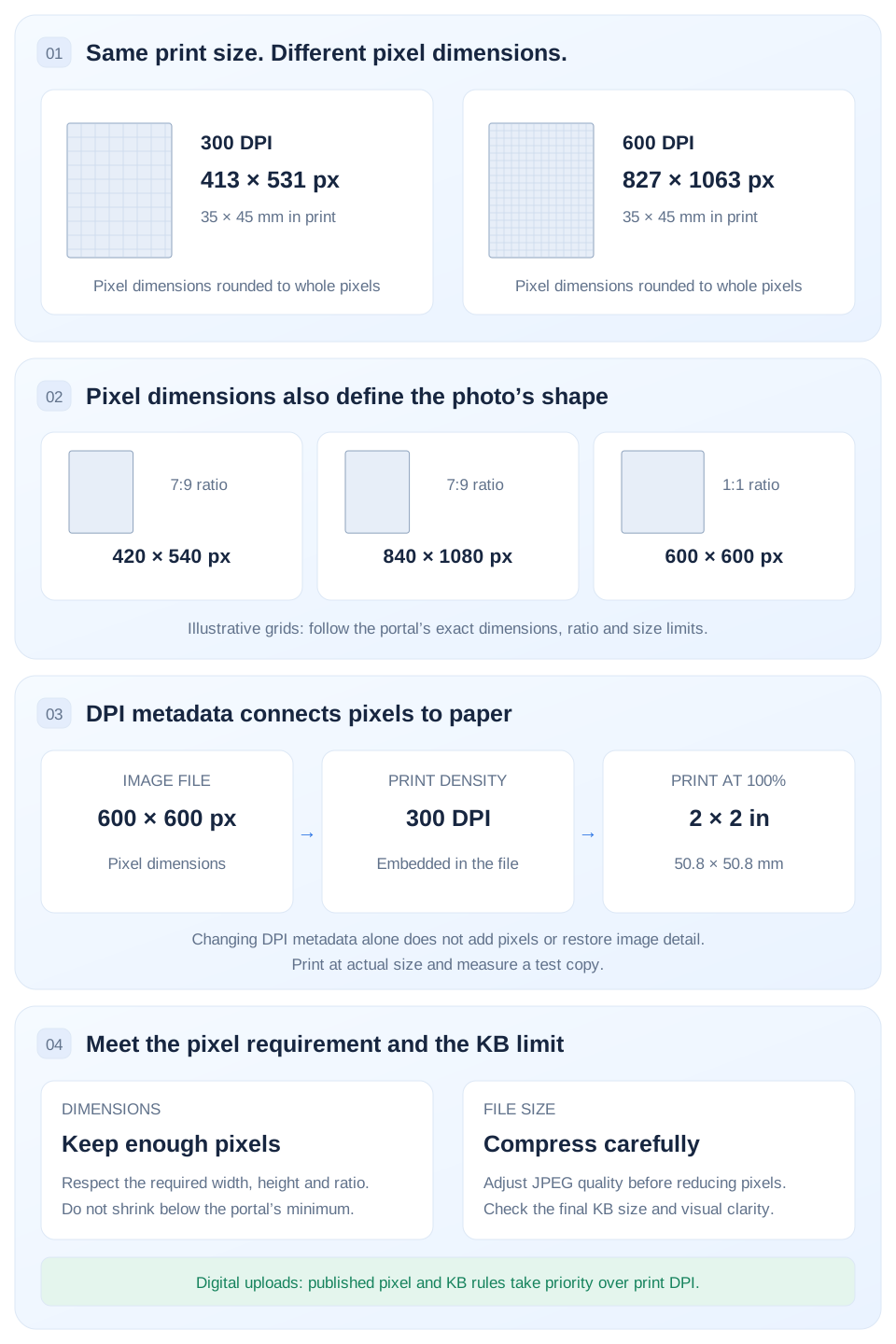
This is the core idea and it is worth being precise about. A specification says the photo must be 35 mm wide. A pixel count says how much data describes that width. The bridge between them is DPI, dots per inch. At 300 DPI, 35 mm needs 413 pixels; at 600 DPI it needs 827. Both files print as an identical 35 mm photo, one just carries four times the data.
So when a tool tells you a passport photo is "413 by 531 pixels" without mentioning DPI, it has quietly assumed 300 for you. That is usually the right assumption, but it is an assumption.
Official minimums
IRCC asks for at least 420 by 540 pixels. The Singapore ICA asks for at least 400 by 514. Chinese visa uploads want 354 by 472 up to 420 by 560. These are not arbitrary: they are rounded results of converting a millimetre size at some assumed DPI. IRCC's 420 by 540 is a clean 7:9 ratio, exactly the shape of a 35 by 45 mm photo.
Recognising the ratio is useful, because it tells you the authority cares about shape and minimum detail rather than a specific pixel grid. Anything larger with the same ratio is normally fine.
Print exports
There is a failure mode here that catches almost every browser-based photo tool. When a canvas is exported to JPEG, the encoder writes a JFIF density of 1 by 1 with the units field set to "no units", meaning the file declares no physical size. Printers and photo labs then fall back to their own default scaling, and a pixel-perfect crop comes out at the wrong physical size on paper.
The fix is to patch the JFIF density fields after encoding so the file carries a genuine DPI. This site does that on every export. If you use another tool, print one copy and measure it with a ruler before committing to a full sheet.
File size
More pixels means a larger file, so pixel and file size limits fight each other. The US is the tightest case at 600x600 minimum and 240 KB maximum. In that situation, staying near the lower end of the pixel range leaves more room for quality. Where the ceiling is generous, as with IRCC's 4 MB, go well above the pixel minimum instead.
Applying to Canada?
GetNorthPath builds free DIY immigration tools: eligibility helpers, CRS and document checkers, and guides for every major pathway. Start with a tool, or book a short walkthrough so the team can show you how one works.
Product help only. Photo tool stays free either way.